Osteoporosis is the slow deterioration of bone mineral tissues, which ultimately leads to fractures and severe breakage of bones.
IS IT A NATURAL SEQUEL TO AGING?
Yes. After the age of 30, bone loss is greater than new bone formation, leading to deficit in bone density. Women have 10 -15% Lesser bone density than men, and they lose more bone during menopause, so they are more prone to Osteoporosis.
WHAT IS BONE REMODELING?
The bones in our body are dynamic structures with bone loss and new bone formation taking place continuosly. Normally there is a balance but when bone loss is more than bone formation there is a deficit and Osteoporosis may set in, if not corrected on time.
ARE THERE OTHER RISK FACTORS AND CAUSES OF OSTEOPOROSIS?
Yes. Some of the common causes are –
Medication for asthma and arthritis
Usage of steroid based drugs and anti convulsant drugs
Over dose of thyroid hormones and Hyperthyroidism
Detect Osteoporosis before a fracture occurs
Predict chances of future fractures
Determine rate of bone loss
Monitor effects of treatment
Prolonged bed rest
Lack of exercise
Low calcium diet
Use of cigarettes and alcohol
A small, thin body frame
Family history
Race - Asian women are at special risk
HOW COMMON IS IT?
Osteoporosis is a disease of epidemic proportions affecting millions of people in India alone, majority of these being women. However, this disease affects men, too.
Over 6.1 crore Indians are affected, in which 1 in every 4 women is a victim and 1 in every 8 men over 50 years is at risk.
In fact in women, risk of osteoporosis fracture is greater than breast, cervical & endometrial cancer combined.
WHAT ARE THE SYMPTOMS?
as bone loss occurs without symptoms. People may not know that they have Osteoporosis till their bones become so weak that a sudden strain, bump or fall causes a fracture.
In fact, a vertebral fracture can cause a spine to collapse leading to significant pain, loss of height and stooped posture.
THEN HOW DO YOU DETECT OSTEOPOROSIS?
The best way to detect this silent killer is by examining your Bone Mineral Density (BMD) regularly.
Detect Osteoporosis before a fracture occurs
Predict chances of future fractures
Determine rate of bone loss
Monitor effects of treatment
DO I NEED TO TAKE THE TEST?
Yes. Because the disease is common and if you have any of the above symptoms, it is necessary to rule out the possibility of Osteoporosis, or treat it before it leads to fractures.
Detect Osteoporosis before a fracture occurs
Predict chances of future fractures
Determine rate of bone loss
Monitor effects of treatment
HOW OFTEN DO I NEED TO TAKE THE TEST?
For preventive recourses, BMD is advisable only 3-4 times through the lifetime, from the age of 50 years onwards.
For Osteoporosis treatment, the test may be done yearly or even 6 monthly to monitor the bone condition and progress.
HOW DOES THE DEXA - BMD WORK?
DEXA – Dual Energy X-ray Absorbitometry, uses small amounts of dual energy X-rays with different rates of absorption in bones and soft tissues.
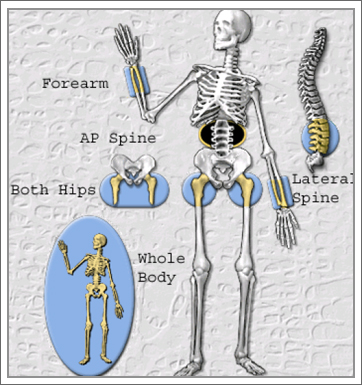
Accurate images of the forearm, hip, spine or even the whole body are easily produced. Most importantly, this procedure measures precisely the amount of mineral present in the areas that are most susceptible to Osteoporosis fractures.
ARE THERE CHEAPER MACHINES FOR MEASURING BONE DENSITY?
Yes, there are cheaper machines available, especially the ultrasound based machine, which measures the heel. However it is not accurate. DEXA is the ‘GOLD STANDARD’ as described by WHO.
Accurate images of the forearm, hip, spine or even the whole body are easily produced. Most importantly, this procedure measures precisely the amount of mineral present in the areas that are most susceptible to Osteoporosis fractures.
WHAT IS THE OTHER BODY COMPOSITION INFORMATION DEXA PROVIDES?
In addition to the accurate Bone Density information, a high end Body Composition software provides accurate calculation of total fat, lean muscle mass and its regional distribution in the body. It is very useful if you are on a weight loss programme or obesity management or active sports person because it can actually guide on weight, fat and Muscle management of your own body. Customised regions of interest can be perfectly analyzed.
IS IT SAFE?
Yes. X-ray absorption in Dexa BMD is about one-tenth of that received from a chest x-ray or as much rediation as one is exposed to during one intercontinental flight. Thus the radiation exposure is quite low.
WHAT INFORMATION WILL THIS TEST GIVE MY DOCTOR?
A bone densitometry test aids in the diagnosis of Osteoporosis. The test allows your doctor to compare your bone mineral density (BMD) to that of a ‘young adult’ at peak bone strength (T-score). It also compares your result to people of your same age, called ‘age matched’ (Z-score). Your T-score is one of that your doctor will definitely consider in making a diagnosis. This information, along with other factors, helps doctors gauge your risk of osteoporosis fracture.
WHAT IS THE SIGNIFICANCE OF T-SCORE?
World Health Organization (WHO) has developed categories, with T-scores, that define the amount of bone loss, for women.